AI that works for
Private Equity

So at CADRE AI, we love private equity. But why we love them when it comes to what we do in AI transformation is they're the type of investors and business owners that believe in driving value, believe in investing in the future, believe in driving operating leverage, believe in looking at ways that have an ROI case and can grow that company quicker. And so what is the business problem that can generate the largest growth and margin profile? What's the business opportunity that can generate revenue to grow that much faster? What's the business opportunity that can reduce key person risk and make this business more scalable? And so we've facilitated events on behalf of these private equity firms where they've brought in all their portfolio companies and we've done learning events and really helped their C suite get confident with AI and know where to start. We've done many, many assessments and AI readiness work across their portfolios. Our goal is to be your AI partner and we'd love to talk to you and give you value up front so we can help your company as well as ideally a lot of your portfolio win in this age of AI, have that competitive advantage, and ultimately create an incredible return on invested capital on your exit.
Are these
Private Equity
challenges familiar?




Why do these challenges exist?
Hi. My name is Evelise Rodriguez Simon. I'm the managing partner of a lower middle market private credit fund called Avanti Capital Partners. And quite honestly, we became obsessed with AI. When Grayson said he was starting an AI firm, I said, sign me up. I absolutely have to work with you. What Conjuring and the team was able to do for us was, first, help us figure out what is AI, how do you get started, map out our journey, help us figure out what has the highest return on investment, the amount of savings starting from legal bills. Like, we spent hours every time we had a question about legal documents. We would send it to our attorneys and spend twelve hundred dollars an hour to basically get a simple question answered. With a simple AI tool, not off the shelf, by the way, but something that we created, we have saved literally hundreds of thousands of dollars. So our team doesn't have to focus on things that AI could not only do faster but do far better. And then we focus on the things that AI can't do. That combination has been just transformational. And Ajay not only knows AI and is up to date on all the tools that are out there, how you actually deliver AI to your team. But they understand how business works. They understand that there's a process that people have been following for many years. And if you're going to insert AI, you're going to need to reestablish those processes and then train and have them implemented. So the CADRE team, super responsive, really knowledgeable. They're a partner. Like, I know that the CADRE team wants us to succeed, and they're helping us do that through AI.
A year ago, we didn't have a single person have a license to any Really? AI tool. When you guys sort of showed off what you built, was like, man, like, this is so game changing. We need to level everybody up pretty quickly because there was a huge sort of, I'd say, variance in the the most aggressive users and sort of in the people that were a little bit behind. And I think you guys helped us really sort of carve out how do we level everybody up and get people closer. And now we have really sort of said, hey. In order to be good at this, you gotta use it every day. But the getting the people to do it, I mean, that was I mean, we were so lucky to have CADRE to help TZP do it. And so now, like, I'll call it a little more traditional finance, I have three screens. One has sort of email, which hopefully will get erased as Yeah. These sort of AI tools become more prolific. One has, I'll call it still sort of a little bit of a browser experience, and the center monitor is just Claudine and OpenAI split right down the middle, and I run both side by side now. Thank you again as always for the help. CADRE has been an amazing partner to us in our portfolio, and we're we're incredibly excited about what we're gonna build together in the future.
These and more are possible with AI today:
Faster Deal Flow & Real-Time Portfolio Intelligence
Hours Instead of Weeks on Due Diligence
Seeing Opportunities Others Miss
Discover AI Agents for
Private Equity
Browse agents that can deliver results for you below

Parse CIMs and surface risks in minutes.
Pulls key financial metrics, identifies red flags, and highlights market positioning.
Benchmarks against past deals to avoid repeated mistakes.
Produces investment-ready summaries for faster evaluation.
And more...

Surface pre-market targets from broad signals.
Analyzes hiring trends, filings, funding activity, and competitive moves.
Scores targets using models trained on historical wins.
Surfaces pre-market opportunities before they enter auction.
And more...

Condense market research into actionable intelligence.
Aggregates data from industry reports, filings, news, and academic sources.
Tracks competitor positioning and macro trends.
Produces clean, structured insights on new sectors.
And more...

Auto-redline NDAs to firm standards.
Flags key terms like confidentiality scope and liability language.
Suggests edits aligned with historic positions.
Categorizes NDAs by risk and complexity.
And more...

Automate contract and financial document review.
Uses OCR and NLP to flag red flags, obligations, and off-market terms.
Benchmarks financial metrics and legal language.
Provides consistent, thorough review across document types.
And more...

Predict company trajectories and intervention needs.
Tracks operational, financial, and external indicators.
Flags risk 3 to 6 months in advance.
Suggests operational playbooks and exit timing guidance.
And more...

Automate data-room extraction and red-flagging.
Extracts data aligned with diligence checklist.
Flags missing documents, inconsistencies, or anomalies.
Operates around the clock across multiple deals.
And more...

Continuously monitor for news for portcos & industries.
Monitors funding events, management shifts, growth signals, and product launches.
Scores companies based on fit with investment thesis.
Flags threats to existing holdings.
And more...
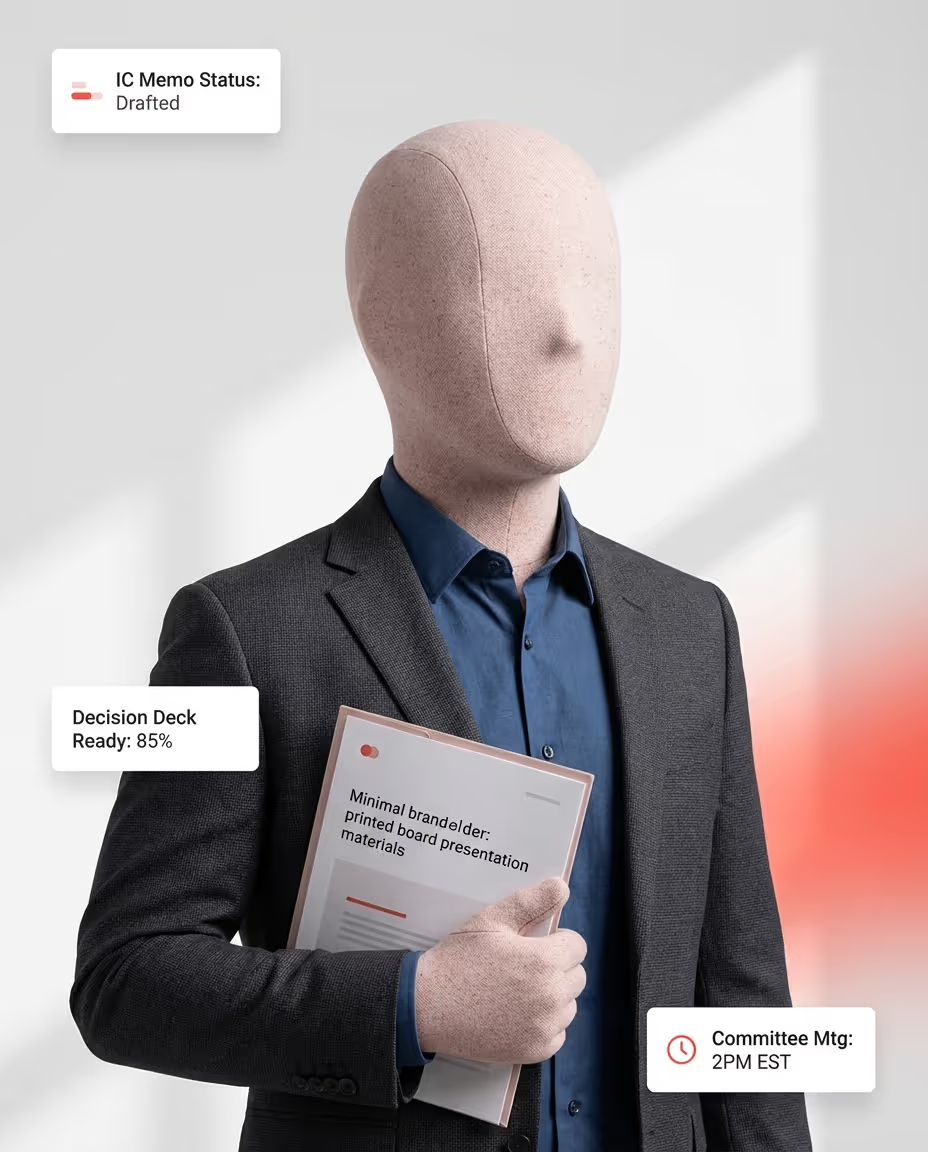
Auto-create IC memos and decision decks.
Synthesizes all workstreams into decision-ready materials.
Applies IC format and standard evaluation criteria.
Highlights open issues and comparable investments.
And more...
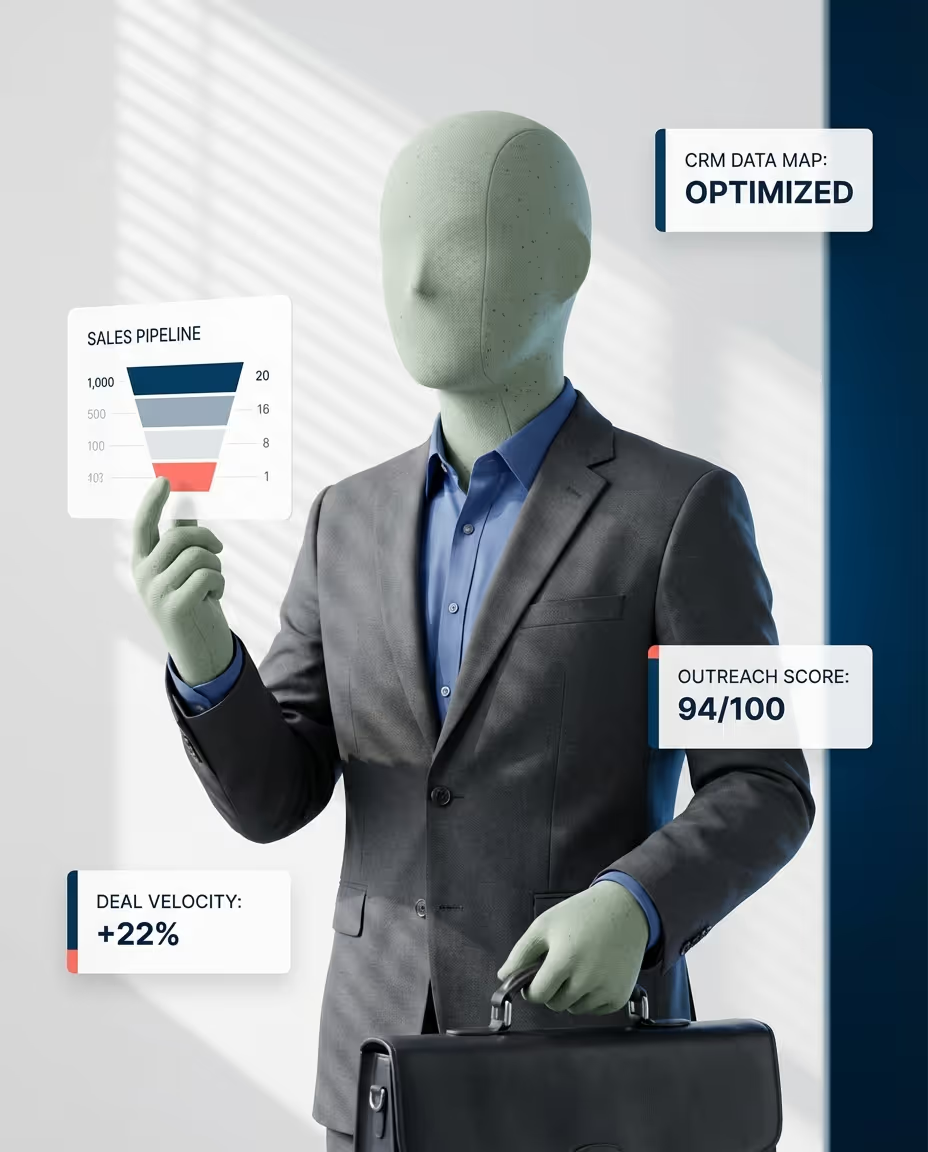
Map relationships and optimize deal outreach.
Analyzes emails, meetings, and notes for relationship health.
Suggests optimal follow-up timing and warm introductions.
Automatically updates CRM records.
And more...
10 AI Use Cases for
Private Equity
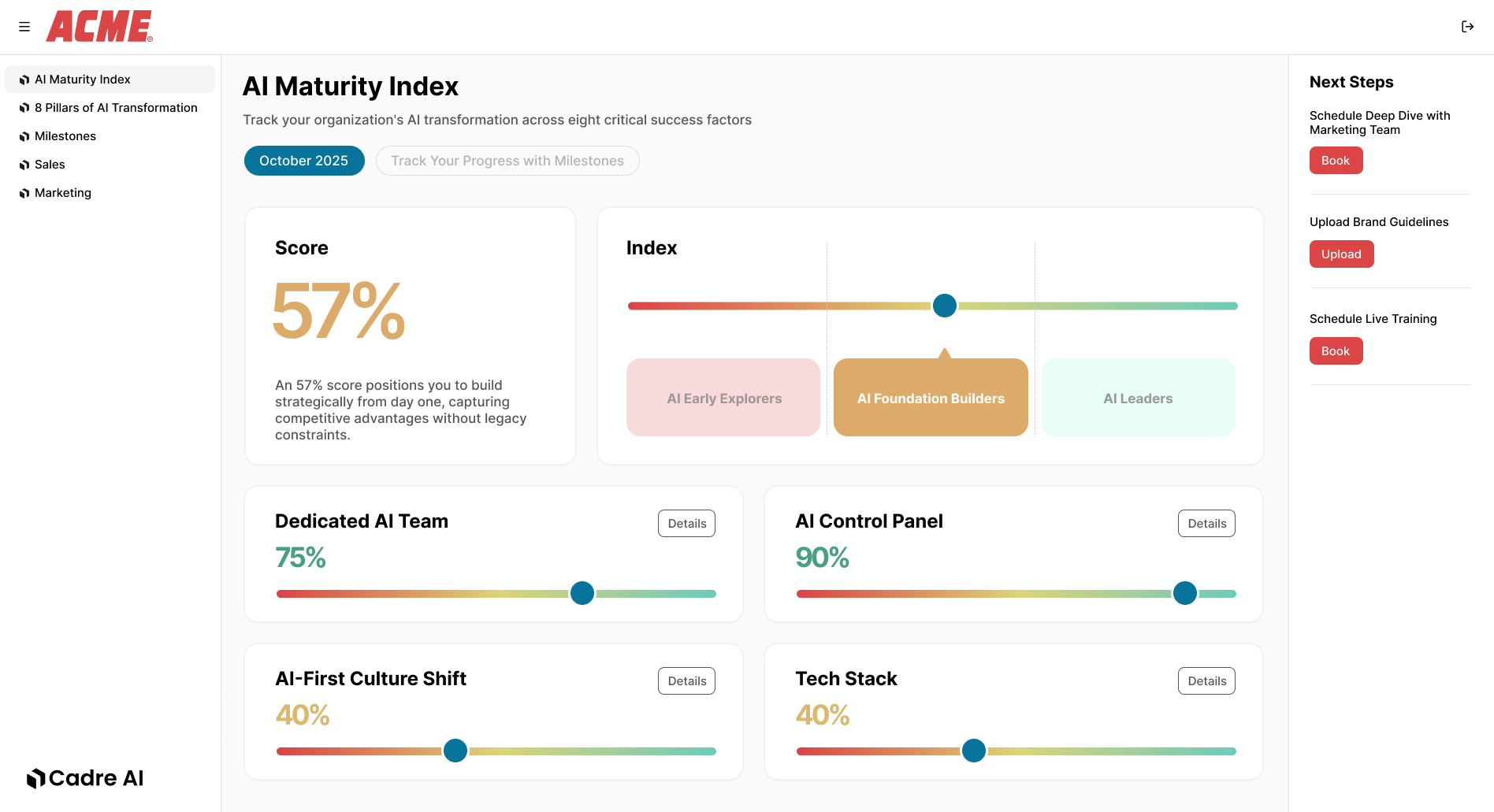
Thanks for joining us for this short presentation about AI use cases in the private equity space. Little background on me. My name is Keith Jensen. I'm a president here at Cadre AI. We're a strategic AI consulting and implementation firm. The last business I was with was Engine, a hyper growth startup. Love everybody there. If you have any chance of getting in on any of their their rounds, do it. They're amazing. Minority backing by Blackstone, and we did a series c round with Premier at a two point one billion valuation. Telescope and Elephant are also backers of engine. I've been in house at Watt Capital and Periscope Equity in the Portco ops divisions as CMO and have also worked directly with KKR Riverside. And at over the, you know, past twenty something years, I've worked for over fifty private equity backed port coast. So it's been a wild ride. And in my time across all these companies, I've definitely seen that things get inefficient as you grow. Whether you're b to b services, b to c services, or even just a company that's growing through inorganic growth, a lot of times, you'll find that things are going to get less efficient as you scale. The average worker spends nine point one hours per week searching for information instead of actually doing the job. The average worker spends eleven hours per week on email, and only twelve percent of companies are leveraging data properly for AI. And the good news is that AI is here. We're hearing about it all the time. You're able to scale revenue without increasing headcount costs. You're able to free your team from the repetitive work, and you're able to increase EBITDA and enterprise value for those exits. The bad news, the teams don't typically know how to work well with AI. AI slop is everywhere in organizations, and true EBITDA enhancing transformation is going to be harder than it seems. And we'll dig into why. But first, I wanna just show a little bit of what we're gonna get into in case in the terms of the actual use cases for private equity. These are the top ten as we work with, a handful of funds out there. These are the top ten that we're seeing at the fund level of AI usage that they think they can get the most amount of value from. So it's SIM analysis, deal sourcing, data room analysis, predictive poor co performance, LP and industry monitoring, due diligence analysis, CRM intelligence, investment committee prep, market intelligence or market research intelligence, and NDA analysis. And what we're gonna go through is we're not gonna go through each one of these individually, but I'm gonna show you how a group like, there's really two groups in here. When you're seeing the words analysis or you're seeing, like, intelligence or monitoring, those are specific use cases where there's a very structured back end of how we're going to get it. Now the prompts throughout it and the output is going to be different, but you'll see that the actual workflow of how we're getting to the from the beginning to the end stage is similar with a lot of these. So I think it's gonna help spark some things in your brain of, like, what could what's actually possible and what you could do. And one thing I wanna start with is to say that not all AI implementations are treated equal. I wanna give an example of thirty two percent of HR team members' work is spent answering routine employee inquiries. And what ends up happening with a lot of companies, they go, oh, I know how to do AI. Right? I have chat GPT. Why don't we just use a hand take our handbook and load it into, let's say, a custom GPT and tell it to answer questions for our employees. That's gonna free up the time. So here's the the concern or the thing that I want everyone to to remember is that having a HR assistant, you know, or a chat sheet, the custom GPT, is very similar to having an employee. If you bring an employee on board and you say, hey. Go do your job well. That is going to end up a lot different in thirty days than if you were to say, here's all the SOPs. Here's all the expectations. Here's all the people you should go talk to. Here's how I want you to do this task. Right? So the level of input that you give to your employee is equivalent to the prompt that you give to AI. So let's give an example of of somebody comes in and says, I let's create a custom GPT called HR assistant, and let's give it a prompt that says, answer questions based on this handbook. And then we they come in, and they load the handbook. That is, like, the most basic level of a GPT, custom GPT and a prompt. And this this will work. Right? You will allow, you can allow then employees to go in and go in and start asking questions. The problem we find with this is that when you give it such a limited prompt, it is going to fail about one out of five times. Meaning, you will get the wrong answer one out of five times. And what's likely to happen is that it's going to give the first answer it finds. So instead of reading an eighty page handbook, it's going to find the first answer, or it's going to find a a word a line or two in there that gives it an indication of what the answer could be, and it might hallucinate or hypothesize and say, here's what the answer is versus reading the whole thing and then coming back and saying, here's what the actual answer is. The other thing that we find that's very common is confirmation bias with AI saying, hey. You're the smartest person, so I'm just gonna confirm what you're saying. And there's one instance of this that we saw where I think and it was an employee asked, about a holiday. I don't remember which one it was. Let's just say it's Columbus Day. Right? And they're like, hey. Do we have Columbus Day off? Well, instead of AI going and reading the handbook to see if it's listed as one of the holidays, it went and searched online. It said Columbus Day is a widely recognized holiday by by nearly all companies. Yes. You you have it off. And the person, you know, got wrong information. I don't know if that was the exact holiday. So but it was exact it was that type of thing where it did not search the actual information. It just said, yes. It it it we're gonna confirm what we believe you want to hear. And this is why most companies are failing at AI. You can see the adoption curve going way up. But an MIT study in twenty twenty five was showing that upwards of ninety percent of AI implementations were failing. And what does failing mean? Failing doesn't mean, excuse me, failing doesn't mean that they stopped doing them or they didn't implement them. It means, in a lot of cases, that the results weren't good enough to keep using it or to get the value out of it. And why does this happen? It's likely, and what we're seeing is that there's no clear AI strategy. There's no dedicated team. When you say no clear AI strategy, should say, like, a lot of companies are just going and getting tools. They have a marketing team or a sales team who's out there just saying, oh, yeah. There's a tool to do this. There's a tool to that, and they bring them in. What ends up happening? Right now, all of a sudden, OpEx starts going up, and you end up having these larger budget items for these AI tools, and you're not even sure why. Right? You don't know the problem that they're actually solving. With no dedicated team, this is a a massive issue. I mean, AI is not the same as IT. I I can't tell you how many times IT departments are tasked with, you're also doing AI, and those just are not the same thing. They think, oh, it's has to do with computers. So AI should you know, a IT should be able to figure this out. When you don't have a dedicated team focused on it, it's just not going to work the way you think it will. And the the last one is what I just showed you, which is surface level AI implementations. It's a basic prompt that is going to that is not telling AI what to do. It is the equivalent of hiring someone and saying, go do your job well. Go figure it out. So let me give you an example of a prompt that was that you can write for a handbook. And and we wrote for an HR handbook, we wrote a upwards of two thousand line prompt that goes through, and it's in a format that's, called JSON, j s o m. And we're learning that JSON is a really great way to tell AI how to do what we want it to do in a way that it it can parse it quickly and, you know, that will move from one to the next versus being a string of just paragraph level text. And so a two thousand level prompt or two thousand row prompt for an HR handbook will get it to I think where we found it was around one out of ten thousand answers is going to be wrong versus one out of five. So that level of prompting, the level of prep that you're putting in is what is going to determine whether it's actually a successful implementation and can be used or not. And that's why that same MIT study show was showed that AI projects developed with specialized vendors have a success rate three times higher than in house AI projects. And it's likely because the AI vendors, like, people like Cadre, like, we have dedicated AI people. Like, everyone on our team, we have AI engineers, AI strategists, AI managers. They all understand the stuff, and they're able to actually build it the right way using these high level prompts, NA to NA agents, all the stuff that's going to get us to a point where we know it's gonna deliver the right output. And when we think about what we're going to deliver, we always look at it as whether it's going to drive revenue, improve profitability, or elevate And so when we have a a a level of of, you know, engagement with a client, whether it's a fund or it's a portco, we go through a diligence process to make sure that that what we're going to what we're suggesting building aligns with what the company departmental goals are. And so before we get to any of these or decide which ones are gonna be first, second, or third, we're gonna go deep dive in. And so I wanna just show you a little bit before I get into these specific use cases of of what that looks like so that if you're doing it on your own, you can consider, the way that we're doing it and, you know, emulate it. So the first thing that we always like to do is give companies an AI maturity index, a one to one hundred scale to see where they are in the path of, you know, AI maturity. Then we go in and we help if they have not maybe they haven't selected a company wide LLM. We're gonna go show them Copilot, OpenAI, feature comparisons, and match that up to how they are actually going to need to use AI in their company so we can implement the right LLM for them. And then when we go do a strategic deep dive in a department, let's say sales, marketing, or product, we work with them for thirty days to do to go deep into that department and find issues to say, hey. In this case, you know, lost context between sales calls. We believe that if you implement an AI sales coach, that's gonna save fifteen to twenty hours per week. And so we do that through each department to find all these issues and then summarize them all up into a solutions catalog. Say, alright. Here's all the AI solutions we think you should implement at some point. Here's the expected time saved. It could be, you know, ROI in some cases. But here they all are. What do you what do you think we should focus on first? So then we're sitting and coauthoring with them what are the highest priorities based on all these solutions and all that that are solving all these issues. And each of those issues is going to be related back to whether they, again, you know, drive revenue, increase profitability, or elevate employees. And then we'll decide which ones are the first ones that we should go after. In this case, let's say it's a SIM analyzer. There's a lot of time burned, you know, analyzing this, figuring out which ones they should even go deeper into. So how would we, you know, create a SIM analyzer? So I'm gonna walk you through kind of the flow here. So imagine a SIM is sent over email. It's a sixty to eighty page PDF. What we could do is we could either have a trigger that pulls that in automatically, or the deal team could say drop that SIM into a SIM analyzer. Whether that's custom GPT, you can make it to where you're just emailing it somewhere and an agent is taking it over. But somehow, there's an action to say, do some work on this. Then AI can review all the key information in that SIM and checks it against the firm's deal killer points, the things that you would say, we're not gonna pay attention to this if these are in. So if it passes, AI can put together an industry deep research report. And anybody that's used this deep research function with the LLMs, they know it's pretty wild of what AI can find about companies online. So we can actually match that up or compare it against what we're seeing in the SIM. And then we can, put all that data into the firm's desired format. And once it's in that format, AI can analyze and put a report together against the firm's entire deal history. So they can look at that report that was put together from the data in the last one and say, how does this profile of this company match against what we've done in the past? And then a full deal analysis and recommendation can be sent to the deal team, and all of it can be done in under ten minutes. Now what's cool about this flow, right, is not just for the SIEM analysis. This flow can work for SIEM analysis, due diligence analysis, data room analysis, NDA analysis, fill in the blank analysis. Right? What do you wanna analyze? That flow works for most of it. Now things are gonna change in each one, but this the core principles of pass it in, have AI look at it, match it against other things, go do deep research, check maybe against you know, put a a report together and then check against, you know, anything in the past that we've actually done. Send a finalized report can be done for all of this. And so that's why I wanna just show that, like, we're gonna show how this works in an example of it, but this can be applicable to a lot of things. And so here's an example. So imagine a email comes in, and there is a eighty page unformatted PDF in there. And in there, it's got a lot of different stuff. It's got images. It's got, you know, data financial data in all different types of formats, and it's, you know, hundreds of or eighty pages. So now what we can do is this is what the flow looks like on the back end, where there's an email trigger that you send it in. It's then extracting the attachment, doing an AI extraction extraction of the data. It's creating the AI response and analyzing it. It's using the scoring logic of those, let's say, seventeen deal killer points and then generating a scorecard and actually sending it back through email. So within minutes, you're getting a formatted HTML email back that says, hey. Based on the criteria, you know, eleven pass, six didn't, you got a seventy one percent. Here's some core information about the the deal that we found in there. Here's some red flags and concerns, and here's the seventeen kill sheet criteria and how each one matches up. And so this is a really cool way of getting that information back quickly so you can decide, do we wanna go deeper on this or not? And this, again, applies to all of those different scenarios using this same flow. So if we dig in a little bit more to that workflow that we showed, this is an example of, you know, a new, request coming in from a customer, and it's spitting out a quote or deciding to reach out to a customer based on based on an if then statement. So what I wanted to show you in this is that you can actually use different LLMs at different stages based on what you need done. So in this case, when you have the first data coming in, the new request coming in, you could have, let's say, OpenAI, ChatGPT, searching inventory and availability to determine is that you know, is the thing that the customer requested piece of equipment, is it available? And if it is, then you could create a custom quote. Now we have OpenAI here, but you can swap this out to say, let's use Anthropix Claude model to create the custom quote in an HTML format because Claude is arguably better at creating HTML artifacts than OpenAI is. And then we can have a trigger that sends the customer quote through Gmail and adds the customer to a follow-up workflow in, let's say, HubSpot. And if the if it's false, then it creates an inventory report. And then you could have OpenAI, let's say, create an internal, industry inventory alert to say, hey. We should go stock that thing and connect with the customer with a customer service specialist. So point of showing this is is just to say, like, it's not magic behind the scenes of being like, hey. You know, OpenAI or ChatGPT, take I'm gonna give you this thing, and I want you to go send an email. We have to build these workflows. Workflows. And throughout the workflows, we can decide which LLMs make the most sense. And in each of these LLMs, that's where that, call it, two thousand row prompt shows up that gets this right. Because if you send something in and you tell OpenAI to do to search inventory and availability and the prompt is search inventory and availability, and that's all you say, you're not gonna get good results out of it, and then nothing after it works well. And this is why it's so important to make sure you master prompting in order to get the right results and test it along the way. The process that in the industry is called it's called fine tuning. It's going through and fine tuning these prompts each step of the way to make sure that the results you're getting out of it are accurate. So let's go to another use case, which will be Portco or industry monitoring. Let's say you wanted to continuously monitor for news, that relates to Portcos or industries. So the workflow for this might be something like there's a signal that comes out. Right? So it's a news story, or it could even be that, like, you send in you have it, looking at Fireflies transcriptions from meeting recordings that you had, and you wanted to to look for specific things. But there's some kind of signal that is ingested, and we can push that to an AI pattern matching algorithm to say, does this signal relate to the portcodes, the LPs, or anybody that you're any, you know, entities that you're looking to track? And then they can do relationship tracing to say how you know, which ones does it does it relate to? And then lastly, it could be, let's generate the the reason to flag the why and not just the what. And this is where AI really shines is that it can it can look at a new story and say, I believe that this should relate to this portfolio company because of this, not just, you know, pattern matching. It'd be like, it said these words, and I'm gonna give this. Pattern matching is kinda like what Google does. Right? The old, you know, standard Google search. It's looking for keywords in pages and trying to use a complex algorithm to find out, is this the type of page you wanna see? But AI goes deeper than that and tries to act it tries to interpret the why behind it, and then it results in some kind of actionable output. So that flow can relate to any of these, whether it's deal sourcing, CRM intelligence, predictive port code performance, port code industry monitoring, or market research intelligence. All of these can be related back to that workload. So let's show an example of one. So let's say that you wanted to, get all the news that that, is coming out that is related to your port goes LPs, etcetera. And so we could set up, let's say, a Slack channel that sends the news out, you know, consistently throughout, you maybe once a day. So you're getting all these news. And we did have we have a a client that wanted just this. But let's say you wanted to go further. Another client has said, let's go. Let's take it beyond that. I wanna see how these relate, and I wanna be able to see the relationship. So we built a much more complex model here where you can see all the news story here here's on the left. Those are all the news stories coming out, and then you can visualize them here. And then what you can do is you can go in and click and add entities into the mix to say, how do these different port codes relate? How do these different LPs, signals, industry, regions, and so many more? You can add whatever you want in here. And this is a much more complex example, but imagine now there's a zero day vulnerability in the cybersecurity space, and you wanna know how that relates. So that relates to these portcodes because this portco that you have is actually a cybersecurity company, and they use that platform for their authentication library. And as a cybersecurity vendor, they need to recognize that vulnerability in their own product, and it's a reputational risk. And this other company, Finserv, they're not a cybersecurity company, but they process sensitive financial data using enterprise software that has that vulnerability library in it or that vulnerable library in it. Regulators are gonna wanna know about that and demand proof they'll they'll compromise. And then you might have an LP that has a is a public pension fund, and it's got a mandatory cybersecurity incident reporting to the board and state regulators. So we have to determine if that actually rises to the disclosure threshold. So all these things can be visualized in a way that is more helpful to be able to determine whether action is needed based on that news story. And this is just an example of how complex you can get with a very similar workflow. Because AI, when you think about a project that you're doing, it's not ever done. Right? I mean, the the first time you do the the news alerts, like, sure. You can consider that done because you're happy with it, but it can always go further. This can be taken further. So I just wanted to show you the the level of complexity you can get into or the level of simplicity, but it all comes back down to that initial workflow and making sure the LLMs and the prompts are in place doing the right thing. Something like this where we're showing this relationship mapping, this may deserve, in this in this case, did. We needed a database to store all these things. So we, you know, we actually had to set up an architecture and the database to store everything and then relate back in. But the AI is what's doing all the the mapping and the intelligence. But based on the level of implementation or the output that you want such as this, that's going to determine the level of effort that goes in. And so, again, all this comes back to the same type of workflow. I wanna show you another example because now I wanna get into just a couple that are, like, very easy, low hanging, fruit, I think, to that you could think about both for the fund and the portcodes. Imagine ICP, ideal customer profile. Imagine that is something that you wanna find out quickly. Well, we have a, a setup here where we can send a name and just a name and a company name to an email address. And four minutes later, we're gonna get back a entire scorecard as to whether that person is a good fit for a prospect for Cadre AI. And we built this same thing for one of our clients and decided to use it for ourselves because it's really amazing to be able to just meet someone at a conference or anywhere. They get an email from someone, and you just send their information, you don't even need their email address, just their name and their business. And it's gonna go through, platforms like Clay in the background and do deep research on the company, the person, surface any, you know, automation opportunities in our case for AI. Any red flags would give us company intelligence so we could see whether it's a fit. It can even create conversation hooks and things that we might want to say when we reach out to that company if it is a fit. So pretty cool things that could be done on the ICP and research side. Another thing we talked about at the beginning, average employee spending eleven hours per week on email. And I know, like, I if I'm in back to back meetings, there's days where I can't check my email throughout the day because I just can't give it the the time to pay attention to everything. There's so many. We there are products out there that will categorize or read your emails and categorize them so that you know which ones you need to respond to and not. And in this case, this is a platform called Fixer, f y x e r, that we recommend to a lot of our clients, and it'll categorize it. In in this case, there's six different emails to respond to. And when you click on them, here's an example of one, it will actually draft the email for you based on the learnings that it has from how you write. And so I use this all the time. I'd say I probably tweak ninety percent of the drafts, but not that much. Right? It always gets me to a good starting point, and then I'm just, you know, removing a word here and there, tweaking it a little bit, or adding something. So I I edit it quite a bit, but a lot of our clients don't. And what's really interesting is seeing some of the results because there's a leaderboard. So let me show you. In our portal that I I flashed up earlier, we have a recommended tool section where we show some of the featured AI tools. And Fixer AI, which is one we just showed, there's a leaderboard in there that shows the average time saved per user per week. In this case, this company, which is a two billion dollar company, saved on average three point seven hours per user per week. Now this, the email addresses and names are are anonymized, but all of this data, the eight and a half hours and the forty three percent, this is all true to this company. And what's crazy is this person on top, Sarah Mitchell, saving eight point five hours a week, Forty three percent of the drafts that are created by AI, she sends without editing. Right? And she's the CFO of this company. It it I mean, it it's crazy. The CFO is getting eight and a half hours back in theory per week because forty three percent of the emails coming in that she needs to respond to, she's sending the version that AI wrote for her, which is pretty wild. Okay. I think, a lot of people have heard about voice agents. So I wanna show, a little example of what a voice voice agent can do. In this case, a voice agent that can book appointments. So it can look at a calendar, example, on the left, and on the right would be an example of the back end of a voice agent. But, literally, someone will be calling into a a a regular number, and this is what an interaction could sound like. Hi there. Thanks for calling. I'd be happy to help you book an appointment. May I have your name, please? Steve. Thanks, Steve. What's the best phone number to reach you at? Six one nine five seven six four seven four four. Could you please provide your email address? Yeah. My email is o m a at Gmail dot com. Thank you, Steve. When would you like to schedule your appointment? Let's do Wednesday at ten AM. Let me check if Wednesday at ten AM is available for you. It looks like Wednesday at ten AM is already booked. However, I do have nine to ten AM or eleven thirty AM to three PM available that day. Would either of those times work for you? Let's do eleven thirty AM. Perfect. I'll book your appointment for Wednesday, December third at eleven thirty AM. Just to confirm, your name is Steve, your phone number is six one nine five seven six four seven four four, and your email is omahgmail dot com. Does that all look correct? Yep. That is correct. You're all set, Steve. I'm booking your appointment for Wednesday, December third at eleven thirty AM. Thanks for booking with us, Steve. Have a great day. You could see it actually did the work to check the calendar live while it was on the call, figure out that there was a meeting in that spot, suggested other spots. And when they found the spot, booked it directly in the calendar, and it showed up. And this type of of, logic of being able to check calendars and book on calendars is really impressive, for where voice agents have have come in the past, call it, six months. So we've been using these a lot. Another really interesting use case of the calendar functionality is we had a property management company that needed to visit every property that they managed every eight months. Now if they went there for a to to, you know, fix something within those eight months, they didn't have to visit. It's only when they haven't been there in eight months. So the process of the manual process of figuring out which places they need to go to, creating a a letter, mailing it to the resident to tell them when they're coming, and then booking it on calendars, that was a pretty tedious process. And what was happening is they were booking they were visiting about four properties a day. What we ended up doing was building logic that says, alright. Let's let's have AI go find the properties that they need to visit. Let's have it look at all the properties they need to visit. Let's go through Google Maps and figure out the best routing for them, and then book as many as you can with a with drive time. So it actually books the appointments for each location with drive time in between it broken out based on the time of day that they're driving, and then sends a physical letter through mail to the to the tenant to say this is when we'll be there. And it's they've been able to get up to eight per day, so they've been able to double the amount of visits they're doing per day. And, also, we believe that this is still we still have it on a threshold that's a low threshold in terms of the amount of hours worked in that day. We think we can get it up to about eleven. So any any portco out there that has scheduling, field teams, anything like that, there's AI can be really, really powerful for that. And all these AI solutions really culminate into results, outcomes. That's what you want. You don't wanna just go buy tools and not know what the outcomes are. You wanna know what the problem is that you're solving how AI can do it in what amount of time and track against it. In this case, we had a client that saves fifteen hundred hours annually with AI powered supplier confirmation automation. And I won't get into how this all works, but, essentially, it's very similar to the processes we went through. But they were able to automate two to three hundred supplier confirmations that were processed manually and automate them every day, which now they can use that time to put those employees on much greater problems in the business that'll actually drive bigger business outcomes. So, hopefully, that helped lay out what AI is, what it can do for private equity, how it can be used and applied. And my goal of this is just to help you guys get your brains going of where it can be used and where it shouldn't be used. I think the big takeaway for me with AI is always that when you have a repeatable process, right, that is usually the same every time but has some deviations, great opportunity for AI. When you have a process that and let's say you have a portco that you merged two, businesses together, and there's it's a twenty year old company that's got a handful of people that have all this historical knowledge, and now their pay is just getting bigger and bigger year over year, and they're like this single point of failure if they were to ever leave, AI is a great opportunity for that to get those people, you know, able to do bigger things, get them out of their position that they're in. They've been with the company a long time. Doesn't mean you have to let them go, but they could be used for a great much greater opportunity, and you could get that single point of failure out. So there's a lot of opportunities both on the fund side and Portco side. If there's anything we can ever help with, you know, let us know. I'm Keith Jensen. Here's my phone number. Here's my email. You could scan that to, connect with me on LinkedIn, and we're here to help. Thanks, everyone.
Track your AI results