Most AI projects follow the same arc. The team builds the system, runs a few tests, sends a launch announcement, and moves on to the next initiative. Three months later, nobody can confirm whether the tool is actually being used. To validate AI implementation in production, organizations need to treat adoption monitoring as a launch requirement, not a follow-up task. According to McKinsey's 2025 State of AI report, only 26% of organizations say their AI deployments have moved past the pilot stage into sustained production use. The gap between "shipped" and "adopted" is where most AI investments go to die. The pattern is consistent across industries and company sizes. The build is rarely the problem. The failure to verify that the build is producing results is.
Why Most AI Launches Stall After the Build Is Finished
The moment the build is complete, the implementation team's attention shifts. The developers start a new project. The executive sponsor checks the box. The end users who were supposed to adopt the tool either never received adequate training or quietly reverted to their old process within the first two weeks.
This is one of the common reasons AI initiatives fail, and it has nothing to do with the quality of the technology. It is a handoff problem. The team that builds the system and the team that uses the system rarely overlap, and the gap between them is where adoption collapses.
In our experience working with mid-market companies on AI implementations, the warning signs are predictable. Usage drops sharply after the first week. Support tickets spike and then stop entirely, not because the problems were resolved, but because users gave up. The dashboard shows a login count of zero for the third consecutive month.
Cadre's implementation methodology includes a dedicated validation phase specifically because of how often this pattern appears. No feature or workflow is considered launched until it has been validated with real users in production and adoption is being actively monitored. The concept is straightforward: if nobody is using it, it is not done.
The organizations that avoid this trap are the ones that define what "done" means before the build starts. Done does not mean the code is deployed. Done means the intended users are performing the intended workflow, producing the intended output, at a frequency that justifies the investment. That definition changes everything about how the project is managed in its final phase.
What Does Validating an AI Implementation in Production Actually Require?
Validating an AI implementation in production requires confirming that the system is actively used by its intended users, producing accurate outputs, and delivering measurable business value within a defined timeframe after deployment. This means tracking adoption metrics, output quality, and business impact as formal launch criteria rather than treating them as optional follow-ups.
The validation process has four components. First, define adoption thresholds before launch. How many users need to be active? How frequently should the workflow run? What constitutes a successful completion? Without these benchmarks, there is no way to distinguish a working deployment from an abandoned one.
Second, instrument the system for observability. If the platform does not track who is using it, how often, and what they are doing, validation is impossible. This is where organizations moving to modern data infrastructure, such as cloud-based warehousing, gain an advantage. They can build adoption dashboards that surface usage patterns in real time.
Third, schedule structured check-ins during the first 30, 60, and 90 days. These are not status meetings. They are user feedback sessions where the team documents what is working, what is broken, and what was never adopted.
Fourth, tie production performance back to the original business case. If the implementation was justified by a time savings projection, measure actual time saved. If it was justified by error reduction, compare error rates before and after. This connection between measuring AI ROI and production validation is what separates projects that survive from projects that get quietly shelved.
The Real Cost of Skipping Production Validation
When organizations skip the validation step, the cost is not just a wasted tool. It is a wasted narrative. The executive team remembers the AI project that "did not work," even if the technology was sound and the failure was entirely about adoption. That memory makes the next AI proposal harder to fund.
Gartner's research on AI project governance consistently points to the same finding: organizations that track post-deployment adoption are significantly more likely to scale AI across additional use cases. The reason is simple. When you can prove the first project worked, the budget conversation for the second project is fundamentally different.
The hidden cost is also organizational trust. When a team is told a new AI tool will make their job easier and then the tool is deployed without training, support, or follow-up, the team's willingness to engage with the next AI initiative drops. Change fatigue is real, and it compounds with every failed rollout.
In one engagement, Cadre worked with a client whose previous vendor had delivered a technically functional system that nobody used for six months. The system was sound. The data connections were correct. But no one had validated whether the end users could actually operate it independently. The remediation required rebuilding trust before rebuilding workflows, and trust is significantly more expensive to rebuild than software.
The organizations that start with a strategic AI roadmap build validation into the plan from day one. They do not treat it as a phase that gets cut when the budget runs tight or the deadline moves up.
How to Build a Production Validation Process Into Every AI Project
The fix is structural, not cultural. Telling your team to "check on adoption" after launch does not work. Building validation into the project plan as a gated milestone does.
Start by adding a validation phase to your implementation timeline. This phase runs for 30 to 90 days after deployment and has its own deliverables: adoption reports, user feedback summaries, and a go/no-go recommendation on whether the implementation met its success criteria.
Assign an owner for the validation phase who is not on the build team. The build team has a natural bias toward declaring success. The validation owner's job is to ask whether the system is actually producing value for the people it was built for.
Define your success criteria in terms the business cares about. "The model has 94% accuracy" is a technical metric. "The operations team processes 40% more applications per week with the same headcount" is a business metric. Executives fund business metrics. They do not fund accuracy scores.
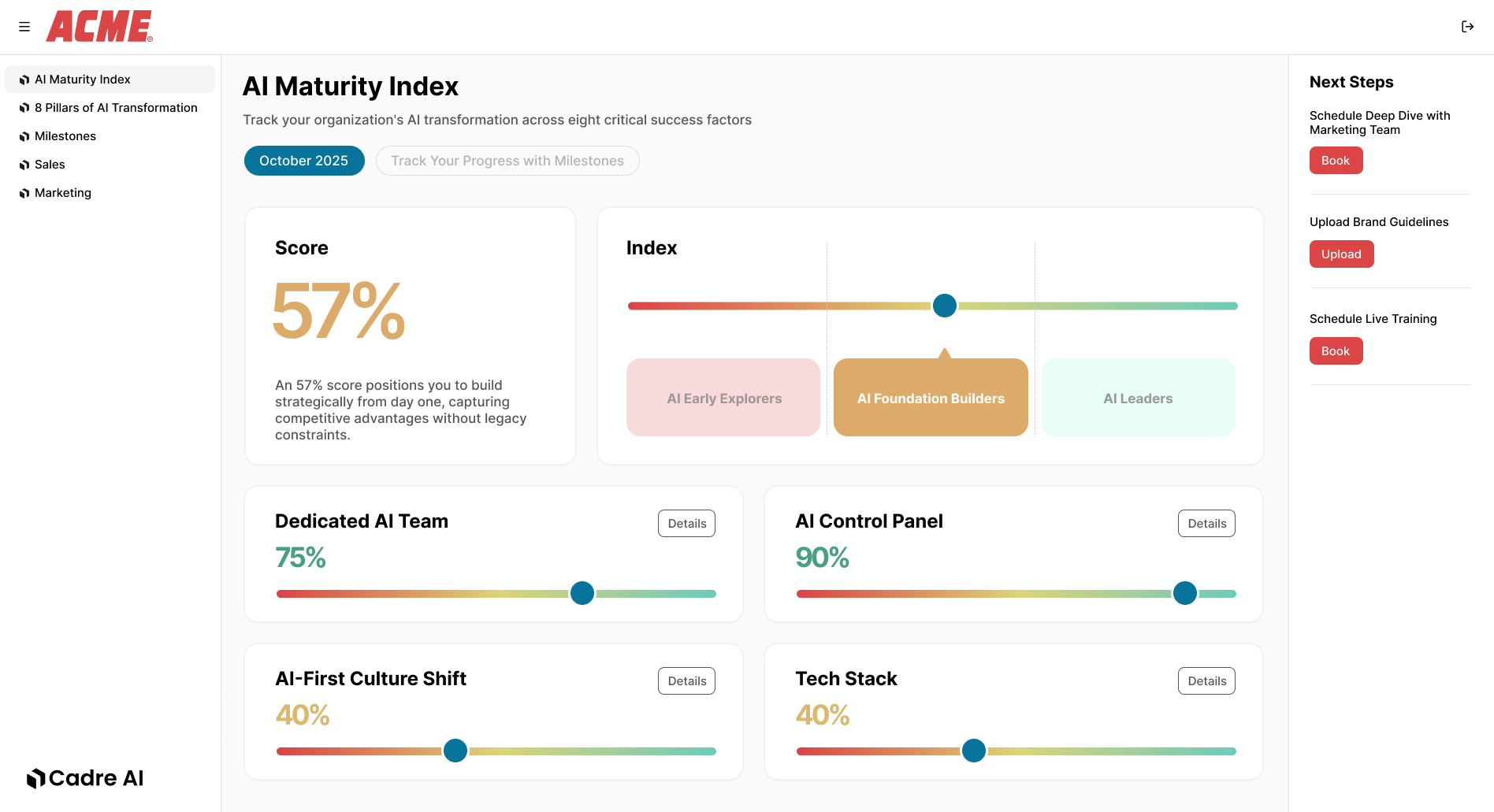
Build adoption monitoring into the system itself. Usage dashboards, session logs, and output quality tracking should be part of the deployment, not an afterthought. If your data infrastructure does not support this level of visibility, that infrastructure gap is the first thing to address before scaling AI further.
Finally, run a formal retrospective at the 90-day mark. Document what was adopted, what was abandoned, and why. This retrospective becomes the foundation for every subsequent AI project at the organization. Without it, the same adoption failures repeat indefinitely.
Conclusion
The gap between a completed AI build and a successful AI implementation is measured in adoption, not features. Every organization that has invested in AI and failed to see results should ask the same question: did anyone verify that the system was being used after it went live?
Production validation is not a bonus step for mature organizations. It is the step that determines whether the investment produces a return or becomes another cautionary tale. Build it into the project plan. Assign someone to own it. Define what success looks like before the first line of code is written. The technology is not the hard part. Proving the technology works for the people it was built for is.
See how Cadre AI builds production validation into every implementation engagement. Schedule a 30-minute AI strategy session to discuss your next project.